

Mathematics

At Widden Primary School, children aspire to be mathematicians; we show them how Maths is used in future careers for once they leave school.
Our school curriculum is based around the value 'ASPIRE'. Maths fosters cognitive development by encouraging children to think abstractly, recognise patterns and process information in a structured war. It nurtures our ability to think critically and approach problems logically. Maths is everywhere. From calculating cooking measurements and estimating travel time, to measuring ingredients for a recipe or understanding patterns in data, we rely on maths to navigate even the simplest tasks. Many future career paths, especially in fields like science, technology, engineering and mathematics (STEM), rely heavily on strong mathematical skills. Early exposure sparks interest in these areas and helps children prepare for those opportunities.
Achieve
Our maths curriculum aims to inspire children to achieve their full potential in mathematics, fostering a strong grasp of essential mathematical concepts. By building on prior knowledge, children make valuable connections throughout their learning, gaining a thorough understanding of mathematical principles. This approach equips them with the problem-solving abilities and logical thinking needed to overcome mathematical challenges and apply their skills in everyday situations.
Resilience
We design questions that challenge children, encouraging them to persist even when problems become difficult. When children approach problems with the mindset of exploring various methods and strategies, they learn to value the process. Mistakes made along the way provide valuable insights into their thinking and offer an opportunity for improvement.
Progressive
We use the small steps from White Rose Maths as the vehicle for our curriculum. Mathematics is taught for secure and deep understanding of the National Curriculum. Teachers make reference to prior knowledge that has been learned and explain to the children how this will impact their future learning. We use Numbersense in KS1 and LKS2 to teach foundational knowledge such as number facts and times tables, which enables children to access maths lessons with increased levels of confidence.
Community
Being proficient in the mathematics curriculum will allow children to become valued members of the community which they can positively contribute to. It is a social subject which enables children to work collaboratively and develop positive learning behaviours that are promoted in the school.
Diversity
What makes maths special is that it's a universal language - a powerful tool with the same meaning across the globe. Though languages divide our world, numbers unite us. We create opportunities for children from different backgrounds to work together, share their thinking, and learn from one another. Group work exposes children to different approaches to problem-solving, promoting the idea that there are multiple valid ways to solve a mathematical problem. This approach helps break down barriers and fosters inclusivity.
Equity
We are committed to inclusivity, ensuring that disadvantaged children, including those with Special Educational Needs and Disabilities (SEND), receive tailored support. This is achieved through carefully designed adaptations, effective scaffolding and the use of manipulatives, allowing all learning to engage meaningfully with mathematical principles. Vocabulary is embedded into our teaching and we use Widgits to make this accessible for all children.
Curriculum Implementation Years 1 - 6
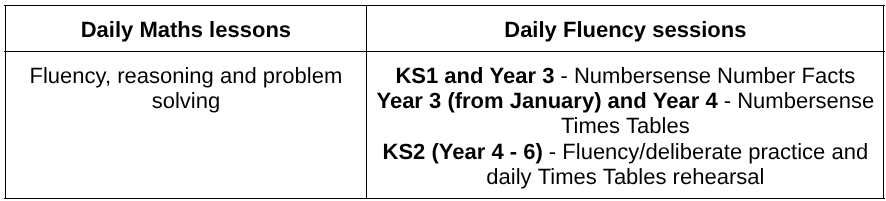
Typical Maths lesson design:
Each lesson focuses on a small manageable step of new learning based on the National Curriculum statements using White Rose.
Recap - involving a true or false retrieval from the previous lesson.
Prior knowledge - exploring with the children previous learning to support the new learning.
Vocabulary - key vocabulary that has been built on throughout the unit/concept to support with oracy.
Input - live modelling from the teacher with pupils using mini whiteboards following the ‘I do, We do, You do’ model. Manipulatives are available for all pupils in order to access the learning.
Fluency task - pupils independently work through fluency questions.
Reasoning - pupils focus on the misconception.
Problem Solving - collaboratively working together to apply their understanding to new problems.
Independent work - pupils continue from their stopping point and compete set questions.
Fluency sessions
In Key Stage One and Year 3, teachers use the Numbersense Number Facts session to teach foundational number skills. Numbersense is a fully resourced, focused whole class session that focuses on securing foundational number skills that can be transferred into their daily maths lessons.
In Year 3 (from January) and Year 4, teachers use the Numbersense Times Tables programme to practice times tables in a controlled way. The sessions are 10 minutes long and are in addition to Year 4 -6 fluency sessions.
Years 5 and 6 have their fluency sessions with a specific focus which is set by the maths lead.
|
|
Fluent 5
Five arithmetic based questions using the Fluent 5 programme. Pupils will practise and retrieve key number skills that they have been previously taught for two sessions each week to develop fluency.
Deliberate Practice
Teachers use formative assessment and INSIGHT objective tracking to identify any gaps in pupils’ learning. This needs to be informed from termly and ongoing assessments and to consolidate learning from previous units of work.
Times Table Rockstars
Teachers provide worksheets for pupils to learn and retrieve times table facts. These worksheets must be used to address gaps in pupils’ fluency knowledge.
Times Tables
In Lower Key Stage Two, pupils take part in daily ten minute sessions dedicated to learning and retrieving times table facts.
We use White Rose Schemes of Learning for our maths planning at Widden. Below are the suggested outlines we follow, although teachers have autonomy to move units around as required.